Bees do more for our landscape than most people ever stop to consider. As a beekeeper, I’ve watched these tireless pollinators drive the fruiting process for countless plants, and it’s a sobering thought that roughly 35% of the human diet depends on that microscopic labour. In the UK, insect crop pollination is worth an estimated £500m a year; globally, it accounts for more than 10% of total agricultural production.
For all that economic weight, honey bees are surprisingly fragile. They’re vulnerable to a group of brood diseases that strike at their most delicate stage of development, and among the worst are the foulbroods: bacterial infections that can turn a thriving colony into a graveyard within weeks. If we want to protect our pollinators, we need to look past the honey and understand what’s actually happening inside the comb.
The names are misleading
The thing that trips up almost every new beekeeper I mentor is the naming. It’s natural to assume American Foulbrood (AFB) and European Foulbrood (EFB) are regional problems, tied to their namesake continents. They’re not. The names have nothing to do with where these diseases turn up today.
Both AFB and EFB are well established across Great Britain, and that mismatch between name and reality can lull beginners into thinking their hives are safe from some “foreign” threat. They aren’t. Both pathogens do serious economic damage to UK beekeeping every year. EFB is the more widespread of the two and spreads fast, but AFB is still the most destructive; it’s earned its reputation as the death sentence of the apiary.
AFB spores don’t give up
American Foulbrood is caused by Paenibacillus larvae, and its real weapon is the spore: a dormant, armoured form of the bacteria that shrugs off temperatures and humidity that would kill most other microbes. Once spores get into a hive, they’re brutally hard to shift.
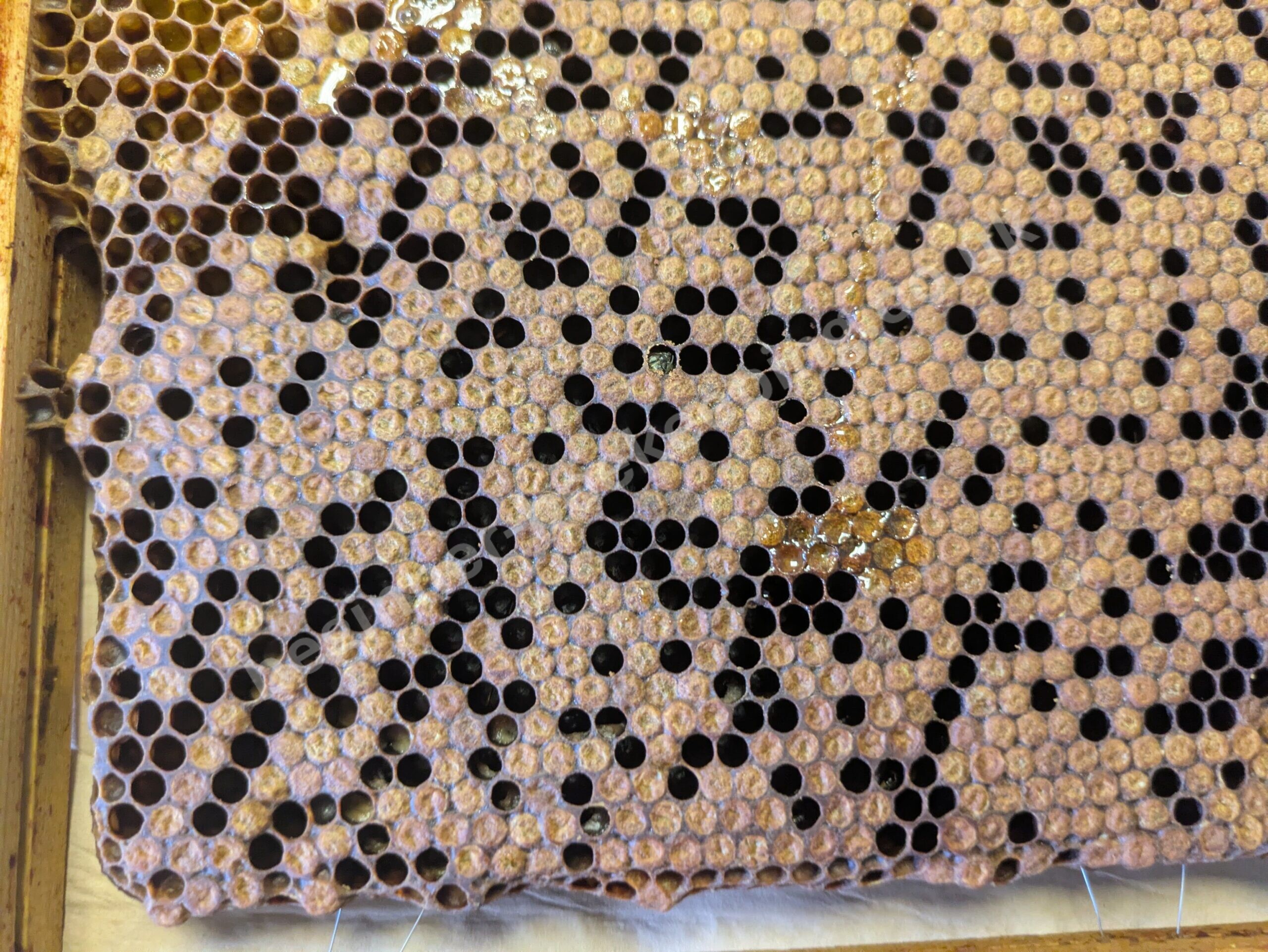
Rare international strains can kill a larva in two to three days. The strains we see in the UK are slower, usually taking around 12 days to reach 100% mortality. By the time a beekeeper spots the tell-tale pepper-box pattern in a failing hive, the bacterial load is already enormous. A single dead larva can turn into a soup carrying up to 2,500 million infectious spores, all resilient enough to sit in the environment waiting for their next host.
Remember “E” for early
Diagnosis is everything in the field. When I open a hive, I’m looking for pearly white larvae curled into a tight, healthy C shape. To keep the two foulbroods straight, I tell my students to remember “E” for early: European Foulbrood kills early, before the cell is capped. AFB kills late, after capping. That’s the core diagnostic difference.
Once EFB takes hold, the change is quick and hard to miss:
The larvae lose their pearly translucence and turn a dull, sickly yellow. A creamy mass of bacteria becomes visible through the skin, filling the gut. The neat C shape collapses into a twisted, slumped coil. Near death, the larva looks melted, flattened against the cell wall. What’s left dries into a dark brown, rubbery scale that, unlike AFB’s ropy mess, lifts out of the cell easily.
Starving with a full larder
Melissococcus plutonius, the bacterium behind EFB, is a gut pathogen, and it kills in a particularly cruel way. Once a larva eats contaminated food, the bacteria multiply until they physically block the digestive tract. The larva can no longer absorb nutrients and starves, even while nurse bees keep pumping the cell full of royal jelly.
That sets up a sneaky cycle. In late spring, when there are more larvae than nurse bees to go round, starvation happens fast. But if a larva happens to be in a well-fed colony, it can survive the infection and emerge as an adult. That’s not good news. Before pupating, these survivors void their gut contents into the cell, coating the comb with millions of fresh bacteria and setting up the next generation of brood to be infected too.
Your bees, your legal duty
Beekeeping in the UK comes with more legal weight than most hobbyists realise until they’re facing an outbreak. Because foulbrood is so infectious and such a threat to national biosecurity, it falls under statutory control. That means your hive is a legal matter, not just a personal one. If you suspect foulbrood, you’re required by law to report it. There’s no waiting to see, and treating it yourself isn’t an option.
The rules are strict for good reason. You must contact the National Bee Unit if you suspect AFB or EFB in a colony (in Scotland, that’s Bees_Mailbox@gov.scot). It’s illegal to remove bees or equipment from an apiary under a standstill notice, and it’s illegal for anyone unauthorised to apply antibiotics to a colony.
That’s why BeeBase registration matters so much. It isn’t just a mailing list, it’s a biosecurity map that lets the National Bee Unit track outbreaks and protect the beekeepers around you.
A future for the hive
American and European Foulbrood are a reminder that the health of our environment often comes down to what’s happening at a microscopic level. These diseases are destructive, but they’re not inevitable. Through careful inspection, the work of the National Bee Unit, and the shared data on BeeBase, we can keep them in check. If we want to keep enjoying what our gardens and ecosystems give us, protecting the smallest, most vulnerable larvae in the hive has to be part of that.